
The Loneliest Super Bowl
What the biggest advertising event in America revealed about culture, community, and marketing.

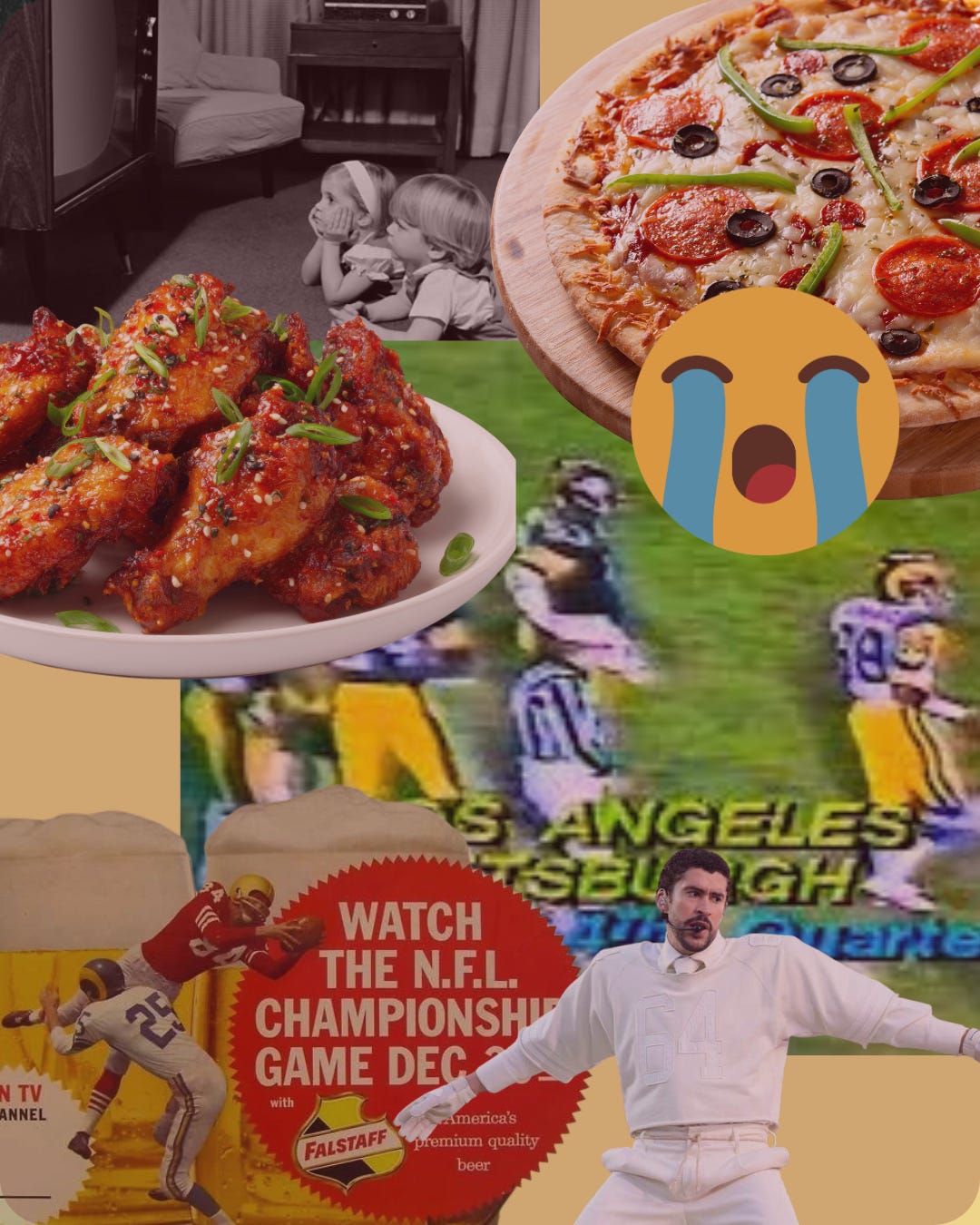
This year on Super Bowl Sunday, I cried in a parking lot.
My husband was traveling for the weekend, so it was just me and my two kids at home. I had spent the whole day looking forward to a Super Bowl watch party at my local gym. I even incentivized my kids: let’s get all our chores done, clean the house, and then we’ll go watch the game. I didn’t want to cook. I just wanted to be around people.
We drove all the way to the gym.
And there was no one there.
The TV wasn’t even on.
After I had hyped up the whole evening for my kids and the plan completely fell apart, I ended up calling my parents and bursting into tears on the phone. At first, the reaction surprised me. It felt disproportionate to what had actually happened. But the more I thought about it, the more I realized I wasn’t just reacting to a disappointing Sunday night. I was reacting to what the Super Bowl has meant culturally for most of my life.
Growing up, football actually wasn’t a huge part of my family’s identity. We were a Midwest family living about thirty minutes outside of Philadelphia, but we weren’t die-hard Eagles fans. What we did have, though, was a massive Super Bowl party every year. Fifty people, easily. All the adults would gather in the living room watching the game while my mom made sloppy joes and wings in the kitchen. The kids would take over the basement, playing until someone yelled that the halftime show was starting. Everything would pause for a few minutes while everyone watched together.
For a few hours, it felt like the entire country was doing the same thing at the same time.
The Super Bowl wasn’t just a game. It was a ritual.
Now I’m an adult twenty-plus years later. I moved halfway across the country for my career and my family. We’ve only been in Austin for about three years, and we’re still trying to build our village here while raising two young kids. In that quiet moment on Sunday, it suddenly felt like I was spending another “holiday” alone with my kids.
That was the part that caught me off guard. Why does the Super Bowl feel like a holiday in the first place?
Part of the answer, for me, is professional. I’ve worked in brand marketing and advertising for more than fifteen years. In our world, the Super Bowl isn’t optional viewing. Even if you don’t care about football, you watch the commercials. Every year the industry dissects them like case studies: what was the insight, what audience were they targeting, what cultural moment were they trying to tap into.
My husband and I are known to ruin watch parties because we comment on the advertising more than the game.
The Super Bowl regularly pulls in more than a hundred million viewers, making it the largest television audience in the United States. Brands spend roughly seven million dollars for thirty seconds of airtime, not including the millions more required to produce the campaigns themselves. For marketers, it’s the closest thing we have to the Oscars.
But stepping back this year, I found myself thinking about something else entirely.
Through decades of media investment, storytelling, and repetition, a professional sports league and the advertising industry collectively turned a championship game into something that functions like a national holiday. For many Americans, it sits in the same emotional category as Thanksgiving or New Year’s Eve — a moment for gathering, food, and shared attention.
And yet, unlike those holidays, the Super Bowl is fundamentally a commercial event.
A sports league.
A broadcast network.
An advertising marketplace.
That realization made me reflect on something I think about constantly in my work. Marketing doesn’t just sell products. It shapes culture.
The Super Bowl is proof.
Over decades, advertising helped transform a sporting event into one of the most powerful shared cultural rituals in the country. Which leads to a question I wish more marketers asked themselves: if marketing can shape culture this profoundly, what are we choosing to shape it toward?
Consumption is the obvious answer. That’s the system we operate in.
But the machinery itself — storytelling, shared moments, cultural participation — is powerful enough to do much more than that.
There was another layer to my reaction that night, too. For most of the twentieth century, American culture revolved around shared broadcast moments. Everyone watched the same shows, the same news, the same events. The Super Bowl is one of the last remaining examples of that kind of collective attention.
But even that moment is starting to fragment.
Instead of watching the broadcast live, people watch the highlights the next day. Halftime performances circulate on TikTok. Commercials drop on YouTube before the game even airs. The shared moment gets broken into pieces and redistributed across feeds and platforms.
That night, after I put my kids to bed early, I made a pizza and watched K-dramas alone. The next day I watched some of the halftime clips on YouTube.
And I started wondering if my lonely Super Bowl experience was less about my personal situation and more about something structural happening in culture.
We are moving from a world defined by mass cultural moments to one defined by millions of personalized ones.
Which raises a question I think marketers will have to grapple with more and more over the next decade. If the last fifty years of marketing were built around capturing shared attention, what happens when those shared moments become harder to find?
The Super Bowl still represents the most concentrated moment of attention in American media.
But moments like it are becoming rarer.
And that means the real challenge for brands might not be interrupting culture.
It might be figuring out how to build it again.